experimental data
We are using Sway to study whether AI facilitation can help people talk productively across deep political and moral divides. In an early pilot study, 120 paid participants each spent 30 minutes on Sway discussing a polarizing topic with a partner who disagreed with them. Before and after the discussion, they rated their agreement with nine statements measuring openness to opposing viewpoints. We are planning a large randomized controlled trial that will compare discussions like these with unmediated ones, and a field study reaching students at over 100 colleges and universities in 2026.
Openness scale: nine statements rated from −3 (strongly disagree) to +3 (strongly agree) before and after the discussion (Cronbach's α = 0.89). On every statement, the average shift after discussion was statistically significant and in the direction of more openness.
The conversations
30 min
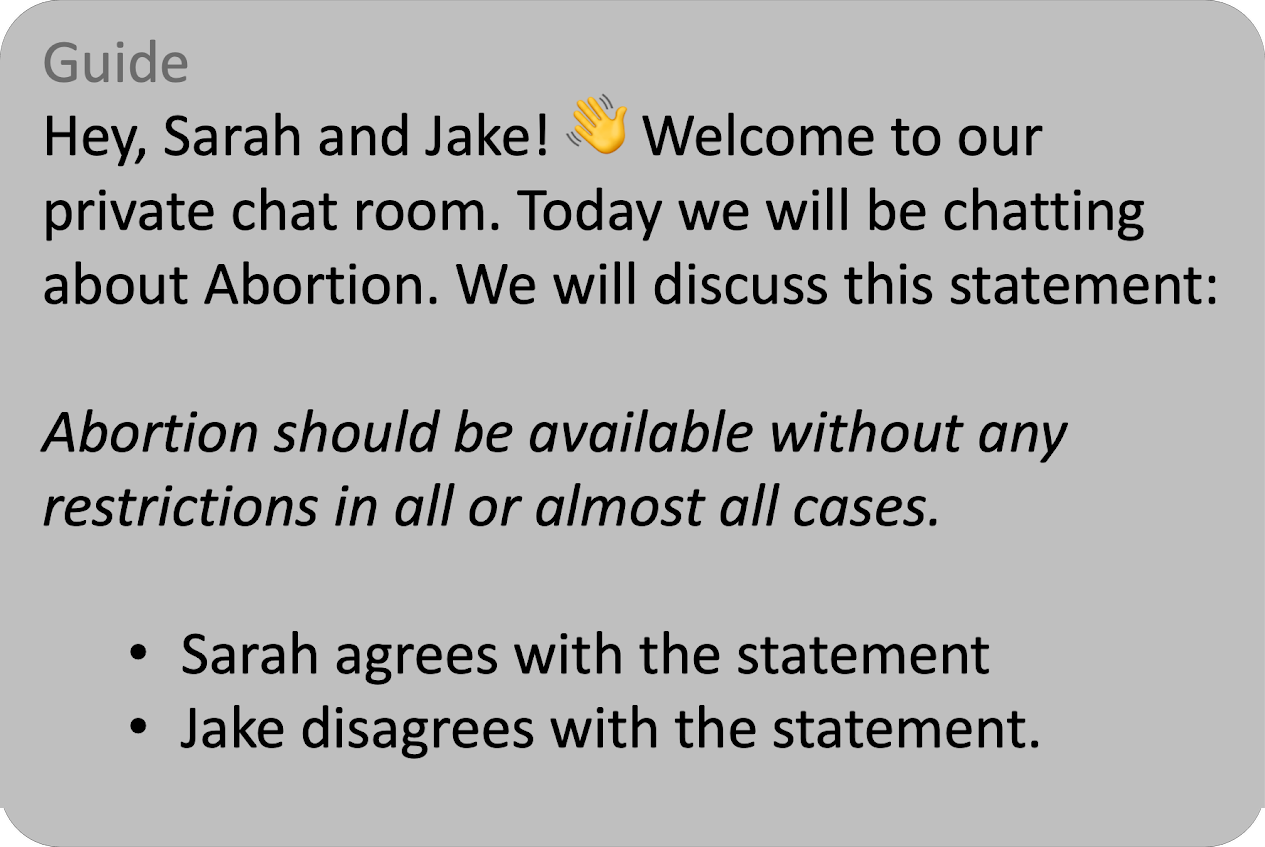
of AI-facilitated discussion with a partner who disagreed. Guide, the AI facilitator, opened every chat by introducing the topic and announcing each participant's position. Topics: the 2020 national U.S. election, the January 6 Capitol riot, Israel-Palestine, U.S. funding for Ukraine, and U.S. abortion policy.
In their own words
Participants gave this feedback after discussing extremely polarizing topics. The comments here are verbatim from post-chat feedback, each labeled with the topic the pair discussed.
This is probably the only way I would ever have a conversation like this. I really appreciated that I could ask Guide for fact-checks instead of saying ‘You are wrong’. The fact that it was mediated helped the tone to stay civil and moved us along.
I definitely think Guide was very useful in leading the discussion. When we got off track, Guide made sure to point us in the right direction. I think this study will be very useful
In a way, I felt safe with guide. I'm sensitive, so having that slight security with the guide, I felt better to speak my mind a little more.
I thoroughly enjoyed it. The guide was a great mediator that really help set the pacing and also control the discussion. Without the guide, I can see the conversation get messy with people talking over one another. It created a thought provoking conversation instead of two people rambling.
I feel like this is the best AI-driven anything that I've ever personally experienced. It asked very thoughtful, relevant, specific questions to direct the conversation. It was patient, encouraging, and respectful.
It was actually amazing. Guide interjected at the right times without being overly intrusive. I went in thinking that I couldn’t compromise, but I left with a more open-minded view. I really enjoyed it.
I found Guide so useful in developing the discussion further. I think it made both parties delve deeper into some of the statements both made. I really enjoyed discussing this topic with someone else. I love the whole concept.
Not only did Sway guide our conversation in a thought provoking way, it moved us in a very civil direction. I was able to see things from my partner’s point of view. I also changed my stance!
Understanding the other side
47%
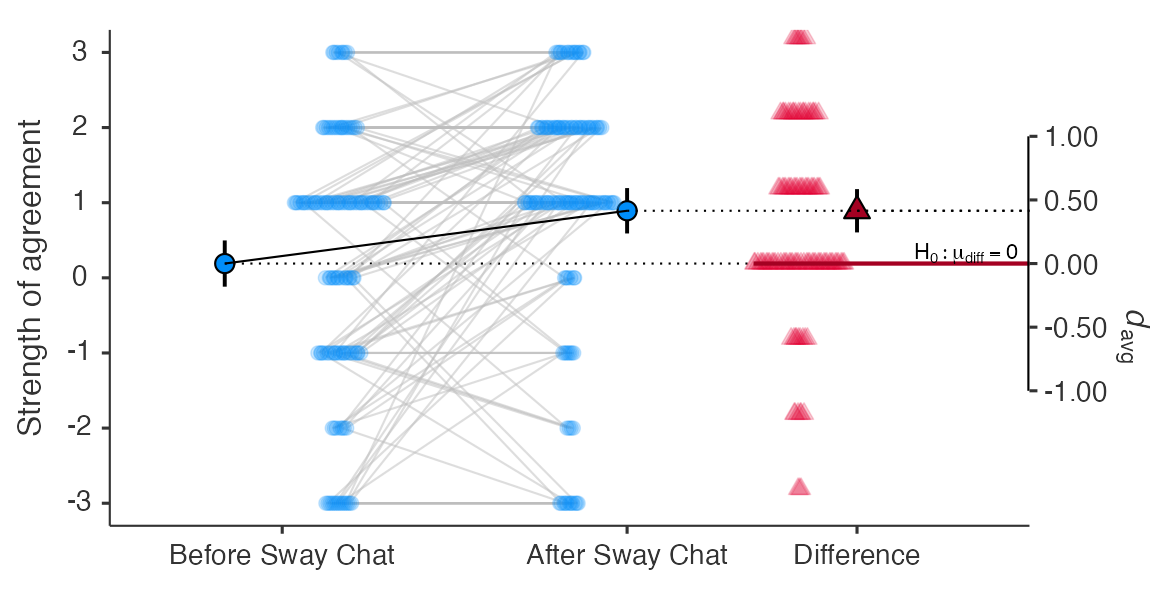
of participants gave a higher rating to “I feel like I can understand people who disagree with me about this topic” after their chat. 14% rated it lower. Agreement rose by 0.41 standard deviations (95% CI: 0.24 to 0.59). The change was highly statistically significant: t(120) = 4.8, p < 0.00001.
Crediting the other side
61%
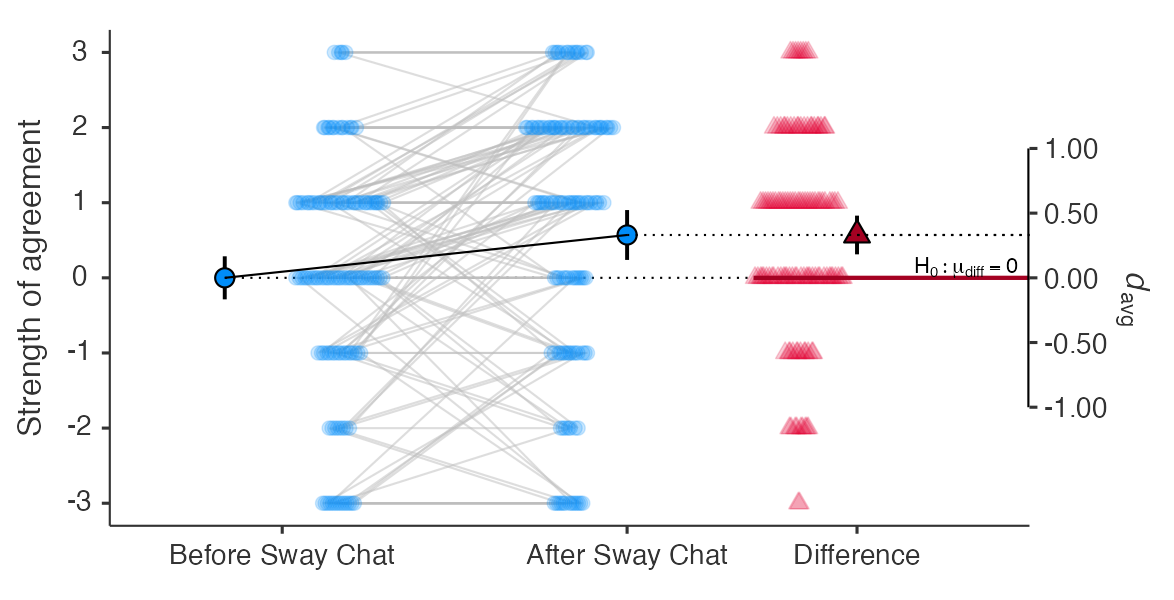
agreed more strongly after their chat that “People who disagree with me about this topic have well-thought out reasons for their views” — more than twice as many as moved in the opposite direction (28%). The improvement was highly statistically significant: t(120) = 4.5, p = 0.0003.
Openness overall
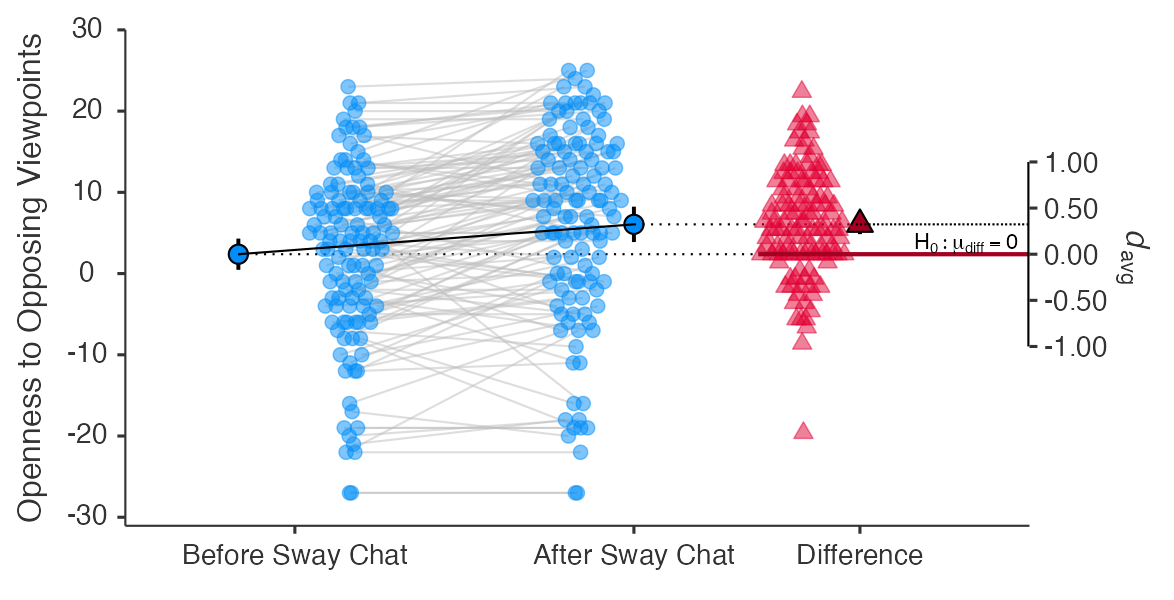
+0.32 SD
average gain on the full nine-item openness scale — a meaningfully large effect. Two-thirds of participants scored higher after chatting with a partner on Sway; one in five scored lower. 95% CI: 0.21 to 0.44; t(120) = 6.1, p < 0.00001. We expect these effects to strengthen and persist after repeated discussions on Sway — a hypothesis we will test in our RCT.
Up next
How these findings hold up in the field, and the material behind them.
Survey data
Post-chat ratings from 14,000+ students completing required course assignments.
See the data →Sample chats
Anonymized transcripts of one-on-one student debates, shared with permission.
Read the threads →Instructor reports
AI-written summaries of classroom debates — the shifts, concessions, and sticking points.
Browse the reports →